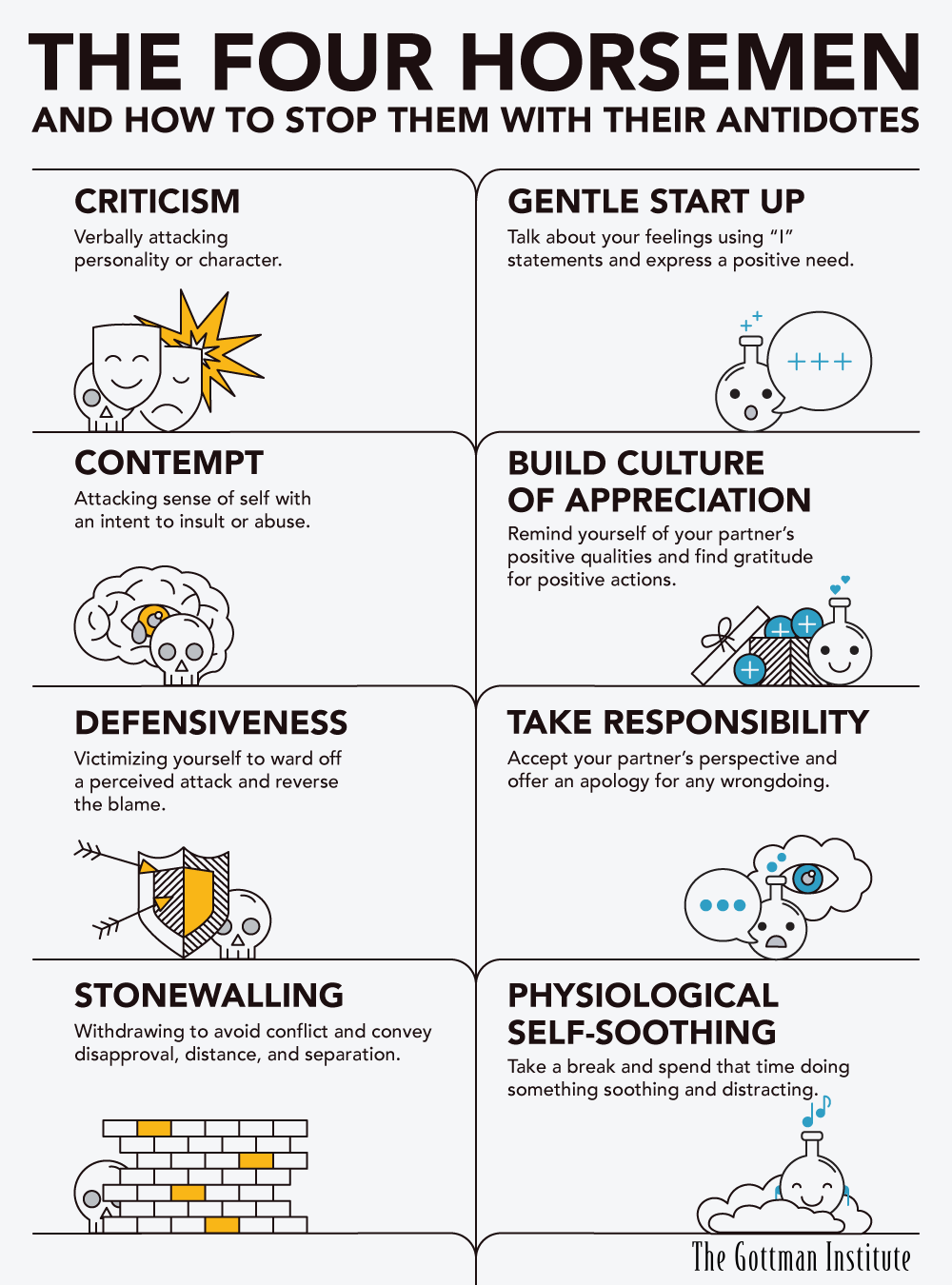
All relationships, even the most successful ones, have conflict. It is unavoidable. Fortunately, our research shows that it’s not the appearance of conflict, but rather how it’s managed that predicts the success or failure of a relationship. We say “manage” conflict rather than “resolve,” because relationship conflict is natural and has functional, positive aspects that provide opportunities for growth and understanding.
And there are problems that you just won’t solve due to natural personality differences between you and your partner, but if you can learn to manage those problems in a healthy way, then your relationship will succeed.
The first step in effectively managing conflict is to identify and counteract The Four Horsemen when they arrive in your conflict discussions. If you don’t, you risk serious problems in the future of your relationship. But, like Newton’s Third Law, for every horseman there is an antidote, and you can learn how and when to use them below.
You can download a free PDF version of the The Four Horsemen and Their Antidotes here.
A complaint focuses on a specific behavior, but criticism attacks a person’s very character. The antidote for criticism is to complain without blame by using a soft or gentle start-up. Avoid saying “you,” which can indicate blame, and instead talk about your feelings using “I” statements and express what you need in a positive way.
To put it simply, think of these two things to formulate your soft start-up: What do I feel? What do I need?
Criticism: “You always talk about yourself. Why are you always so selfish?”
Antidote: “I’m feeling left out of our talk tonight and I need to vent. Can we please talk about my day?”
Notice that the antidote starts with “I feel,” leads into “I need,” and then respectfully asks to fulfill that need. There’s no blame or criticism, which prevents the discussion from escalating into an argument.
Contempt shows up in statements that come from a position of moral superiority. Some examples of contempt include sarcasm, cynicism, name-calling, eye-rolling, sneering, mockery, and hostile humor. Contempt is destructive and defeating. It is the greatest predictor of divorce, and it must be avoided at all costs.
The antidote to contempt is to build a culture of appreciation and respect in your relationship, and there are a few ways to do that. One of our mottos is Small Things Often: if you regularly express appreciation, gratitude, affection, and respect for your partner, you’ll create a positive perspective in your relationship that acts as a buffer for negative feelings. The more positive you feel, the less likely that you’ll feel or express contempt!
Another way that we explain this is our discovery of the 5:1 “magic ratio” of positive to negative interactions that a relationship must have to succeed. If you have five or more positive interactions for every one negative interaction, then you’re making regular deposits into your emotional bank account, which keeps your relationship in the green.
Contempt: “You forgot to load the dishwasher again? Ugh. You are so incredibly lazy.” (Rolls eyes.)
Antidote: “I understand that you’ve been busy lately, but could you please remember to load the dishwasher when I work late? I’d appreciate it.”
The antidote here works so well because it expresses understanding right off the bat. This partner shows how they know that the lack of cleanliness isn’t out of laziness or malice, and so they do not make a contemptuous statement about their partner or take any position of moral superiority.
Instead, this antidote is a respectful request, and it ends with a statement of appreciation.
Defensiveness is defined as self-protection in the form of righteous indignation or innocent victimhood in attempt to ward off a perceived attack. Many people become defensive when they are being criticized, but the problem is that being defensive never helps to solve the problem at hand.
Defensiveness is really a way of blaming your partner. You’re saying that the problem isn’t me, it’s you. As a result, the problem is not resolved and the conflict escalates further. The antidote is to accept responsibility, even if only for part of the conflict.